Examining Provider Approaches to Blending Card Game Traditions from Asia with European Table Formats in Live Environments
Yves Baumann · Sep 14, 2026

Examining Provider Approaches to Blending Card Game Traditions from Asia with European Table Formats in Live Environments
Providers have developed structured methods for integrating Asian card game elements such as sequential betting rounds and community card mechanics into European-style live tables that emphasize fixed dealer positions and standardized chip handling. These approaches focus on rule adjustments that preserve core gameplay while aligning visual and procedural standards across regions.Core Integration Methods in Studio Design
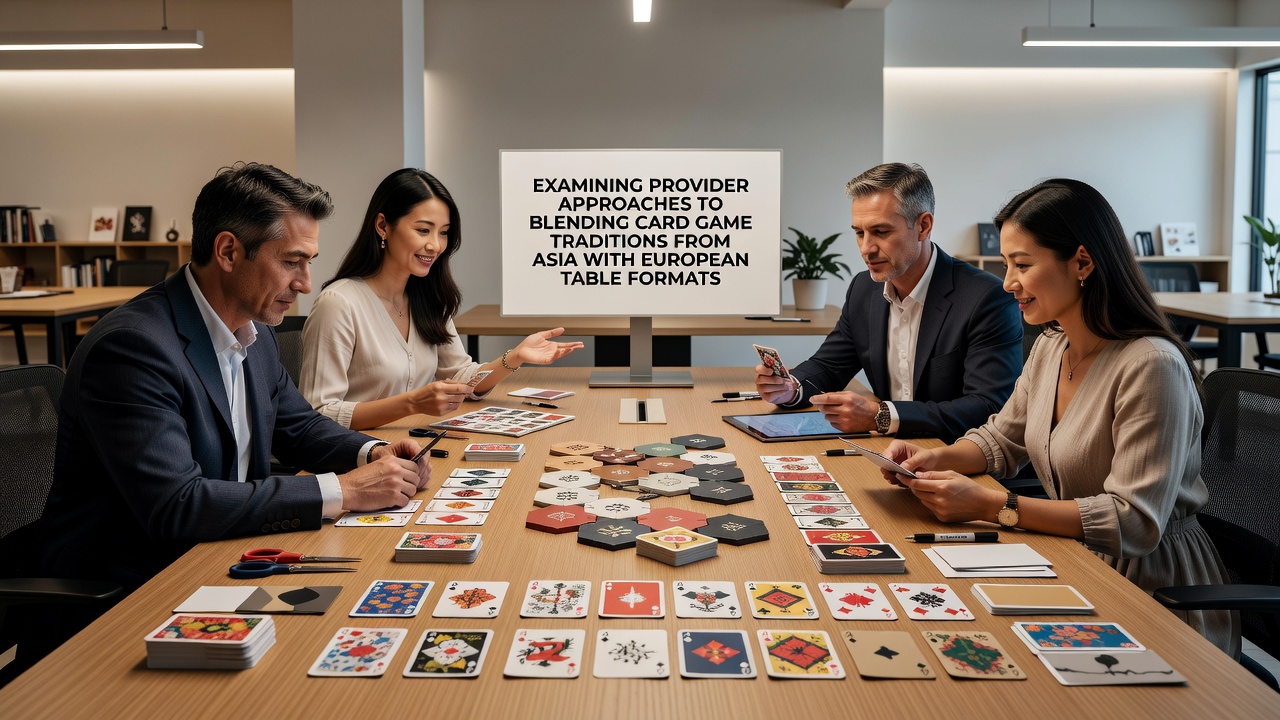
Live environments require precise calibration of table geometry because Asian variants often feature larger communal areas for card placement whereas European formats prioritize individual betting zones. Providers address this by redesigning felt layouts to include modular sections that accommodate both styles simultaneously, allowing dealers to transition between games without repositioning equipment. Data from industry tracking shows that such modular tables have appeared in multiple Asian and European studios since early 2025.
Training protocols form another key component because dealers must master distinct dealing speeds and announcement styles. Asian traditions frequently involve verbal cues delivered in local languages while European tables rely on standardized English phrases. Providers therefore implement bilingual certification programs that cover both systems, with certification renewals scheduled on a quarterly basis to maintain consistency.
Rule Adaptations Across Specific Game Pairs
Blending occurs most visibly when Teen Patti mechanics merge with blackjack table structures. Providers retain the three-card evaluation from Teen Patti but overlay European-style insurance options and side bets that use the same chip denominations found on continental tables. This creates unified payout matrices that simplify accounting for operators while preserving the original hand-ranking hierarchy.
Another common pairing involves Pai Gow poker elements combined with roulette wheel segments. Here the slow-paced tile shuffling from the Asian side integrates with rapid European spin cycles through the addition of timed intervals that allow players to place secondary bets between spins. Observers note that these intervals typically last twelve to fifteen seconds, matching data collected from synchronized multi-table streams.
Technology Supporting Cross-Regional Synchronization
Camera positioning and streaming latency represent critical technical hurdles. Asian games traditionally use overhead shots that capture entire community card spreads whereas European productions favor close-ups of individual player decisions. Providers resolve this by deploying multi-angle rigs that switch feeds automatically based on game phase, with latency kept below 800 milliseconds according to measurements reported in technical white papers from equipment suppliers.
Software overlays further assist by displaying localized rule summaries in player interfaces. These overlays update in real time when a table shifts from one tradition to another, ensuring regulatory compliance across jurisdictions without requiring separate streams. A 2025 industry report from the Canadian Gaming Association highlighted that such overlay systems reduced cross-border compliance queries by approximately 30 percent in participating studios.
Regulatory Alignment and September 2026 Developments
Regulatory bodies in multiple regions have begun issuing guidance on hybrid formats. In September 2026 several licensing authorities plan to review updated technical standards that address minimum dealer training hours and maximum table reconfiguration times. Providers have already submitted documentation detailing their current synchronization protocols in anticipation of these reviews, focusing on audit trails that record every rule change during live sessions.
Academic research from the University of Macau has examined player engagement patterns in blended environments, noting that retention metrics remain stable when transition announcements occur at consistent intervals. Those findings have informed provider decisions about announcement timing and language selection across different market segments.
Conclusion
Provider strategies center on modular table engineering, bilingual dealer training, and synchronized streaming technology that together allow Asian card traditions to coexist with European table formats. These methods continue to evolve ahead of scheduled regulatory updates in September 2026, supported by technical data and cross-regional research that guide ongoing refinements.